

Cassette
Remember cassettes? Those humble plastic rectangles that revolutionized how we listened to and created music? While they may seem primitive by today's standards, these analog warriors played a crucial role in shaping the Nu Shooz musical landscape. From mixtapes and portable music to DIY recording, cassettes weren't just storage devices - they were magical little time machines that changed everything. Let us take you back to an era when the hiss of tape was the soundtrack to innovation...

Image by Bruno from Pixabay
We used to look down on Cassettes. Ten years on, they seemed to lose their high-end frequencies as the iron oxide coating sloughed off the plastic strip. But in the end, we were in for a surprise.
Just TRY to get back to that song you stored on a floppy disc back in 1992, that thing you recorded in Cubase or StudioVision. Back then, if you were an audio engineer, I bet you logged all the mix data like a Benedictine scribe.
Now, here we are in the twenty-first century.
Just TRY to get back to 1992. All the little connectors have changed. Our computers lack disc drives. Not to mention CD drives. The new stuff has no holes or portals or whatever you want to call them to plug the old software in. Your 1992 MIDI file can no longer be read by the current OS.
So, guess who wins?
The Cassette.
The lowly maligned Cassette.
I take back every bad thing I ever said about them.
Compared to all those digital signals you can no longer decode, these plastic rectangles sound wonderfully ANALOG…they bear the whiff of TIME TRAVEL.

A friend of ours, a big Viking named Kevin, turned us onto a documentary called…wait for it…CASSETTE. It was made in 2017. Here it is on YouTube. The main character is an engineer in Denmark named Lou Ottens. In the film, he’s 82 years old. He led the team at Philips that invented the cassette.
The basic idea was that reel-to-reel tapes had to be thicker because they were always being manipulated by human hands. If the tape didn’t have to be handled, it could be smaller and thinner. Dr. Ottens was humble about his own contributions. He led the team. Other people handled the engineering and the aesthetics.
We recommend this film, especially if you were present at the creation. The Cassette changed everything! It was a miracle. You could carry it around.
The Philips team was aware of the fact that Sony was developing the Walkman. At some point, Lou Ottens flew to Japan and met with Sony executives. “We have to agree on a standard format,” he said. “Or else there will be chaos.”
Sony agreed.
The Cassette and the Walkman entered our 20th Century lives at roughly the same time and changed the world in so many ways.
For starters, you could tape other people’s records!
It was the birth of the mixtape.
In 1970’s money, good-quality cassettes were expensive, but you could get cheap ones three-for-a-buck…(Ha! Like Top Ramen!!!) So that’s what we mostly recorded on back in the day.
It’s hard to imagine now, in this era of instant free access to the musical universe, but albums were these precious objects. They cost anywhere from seven to twelve bucks (in 70’s money,) and often, one bought them unheard!
So, if you had a friend with some vintage Coltrane or Smokey Robinson and the Miracles, you sprang for a nice new cassette and raided your friend’s collection. Often, we would draw our own cassette covers! It’s hard to convey how absolutely groovy this was.
And once you taped it, the music was PORTABLE! It’s not like you can walk down the street listening to a stack of LPs.
I was just a junior birdman back in 1975, when I got the bright idea to record a backing track on one cassette deck, then play it back and play along onto a second cassette.
Woo, magic!
I’m not the first guy to do this, for sure. (Reinventing the wheel has always been my modus operandi.) Anyway, every time you go up a generation, the pitch goes up slightly, and you get another bucketful of tape hiss. Each generation of fuzzy background vocals gets higher and higher.
Think Alvin and the Chipmunks in a snowstorm.
One morning, Valerie came downstairs looking slightly irate.
“Who are those girls you brought in to sing on that tape?”
I shrugged.
“It’s just me and the Chipmunks.”
That’s all we had back in the late ’70s.
It took a year to write a song sometimes. There was no way to make it hang together in your head, to make it stand up and walk around by itself. (I’m talking about funk songs here.) Drum machines were in their infancy. We made fun of the Roland 808 back then. It was later to become an essential element of Hip-hop. And anyway, who could afford one?
That’s when I discovered the OMNICHORD.

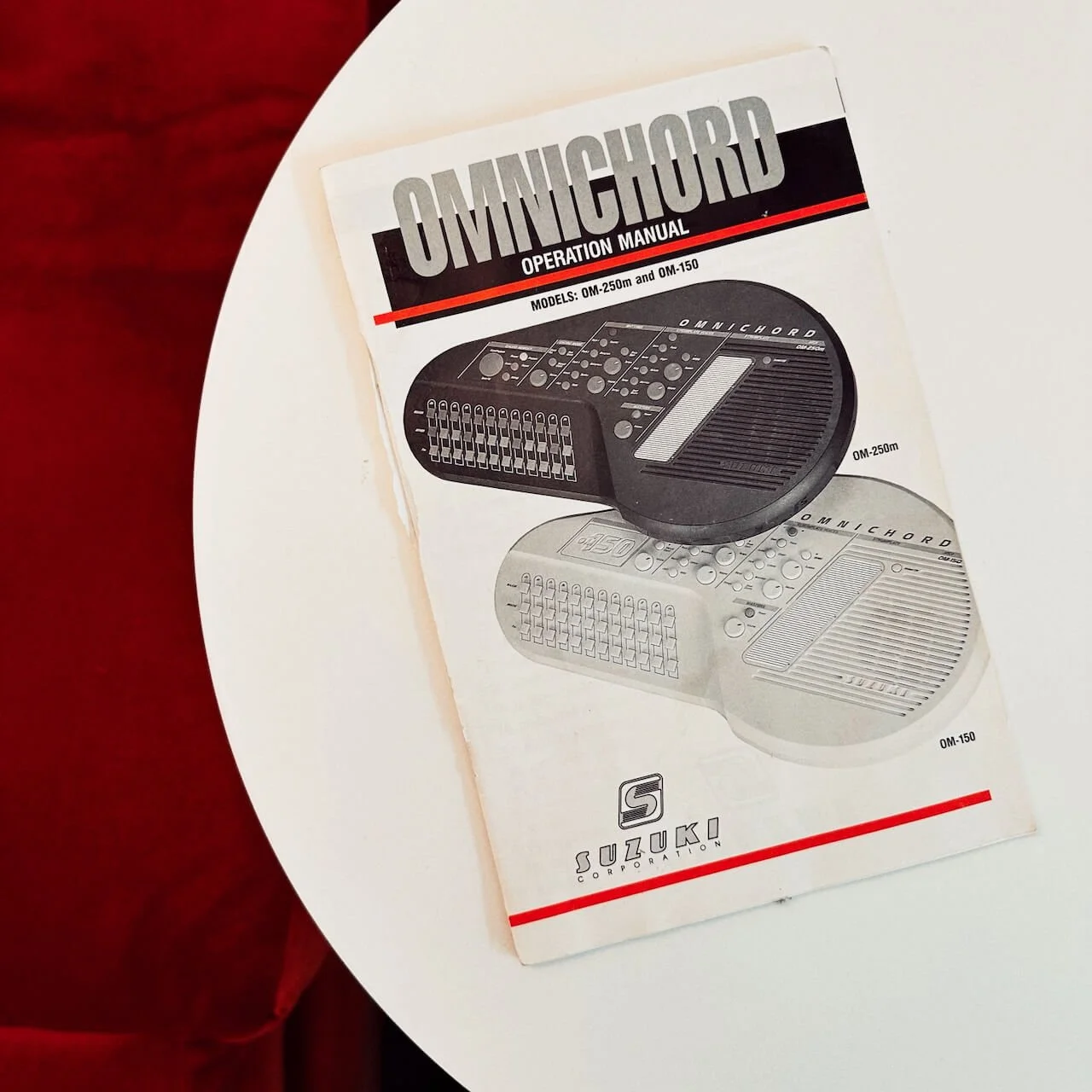
Valerie’s mom, Janet Day, was a celebrated opera singer in the ’50s and ’60s. By the time NU SHOOZ was up and running, she was into Christian music. One day, she came home with this thing called a Omnichord. It looked like a cross between Mabel Carter’s zither and a white Fender guitar pick. It was completely electronic and worked like a zither, I.e., one hand fingering preset chords and the other hand ‘strumming.’
To my delight, it also came with a drum machine!
Close your eyes and imagine the drum beats in those old Home Organs: Swing 1 & 2, Bossa Nova 1& 2, and most important, Rock 1& 2. I recorded these beats at a bunch of different speeds to cassette. At last it was possible to get a little machine help in the songwriting process.
By this time I had a cheap knock-off Walkman, and I spent hours circling the neighborhood writing songs over these tapes.
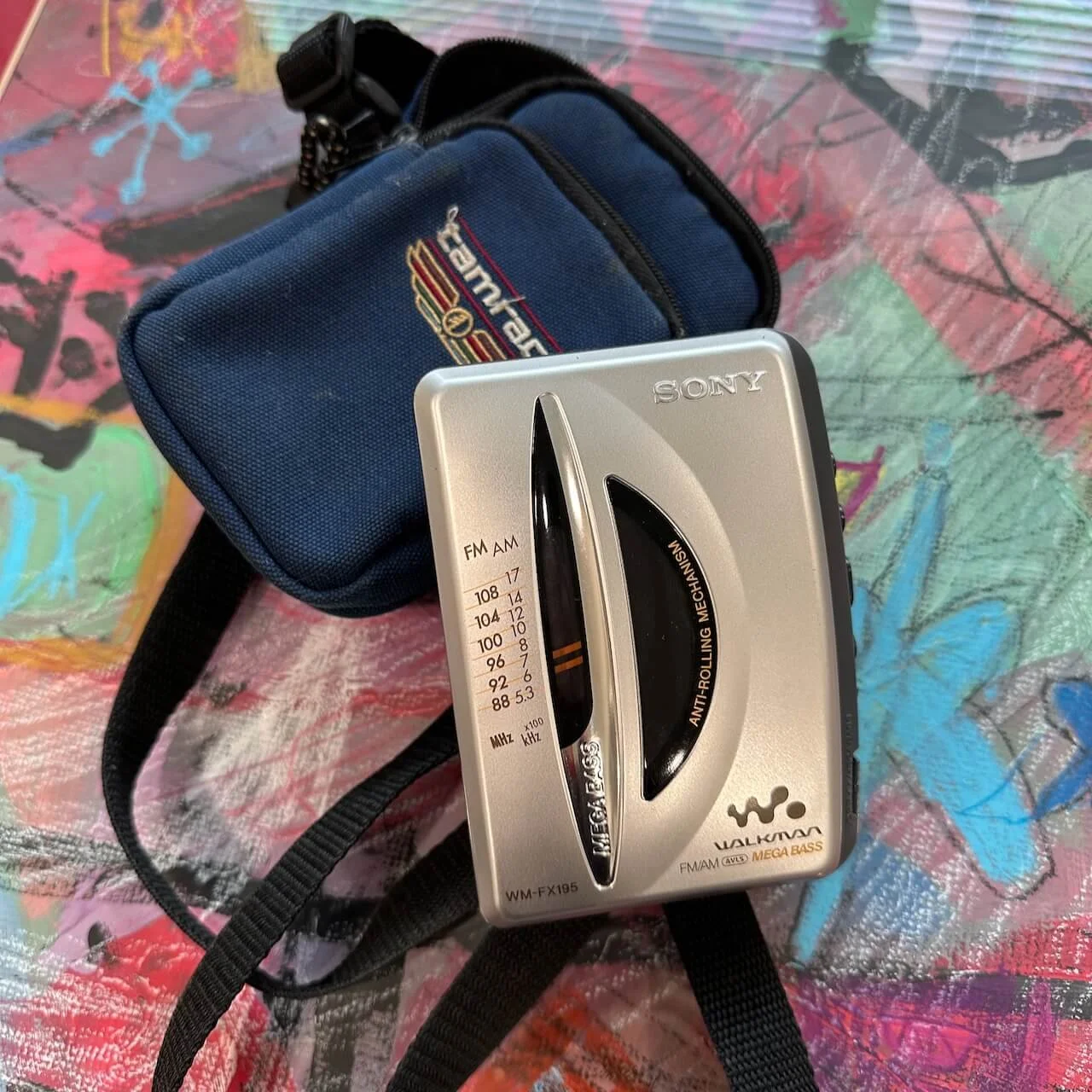
John’s Walkman and carrying case from the early 80s.
Another gift that came with the advent of the cassette was you could tape your own gigs and listen back to them without having to drag around a heavy reel to reel.
Thank you, Dr. Ottens!
Like I said, good cassettes were expensive in ’70s money, so we would re-use the gig tapes. And I’m guilty of burning a lot of live tapes because I hated my singing. I wish I had some of them now. You think certain eras of your life will last forever. Oh, if we were more like the Grateful Dead and saved every live tape…there would be some amazing stuff there. But maybe those days live much better in memory.
In Portland at that time, R&B records were, to quote Bob Dylan, “as rare as hen’s teeth.” The Classic four-horn NU SHOOZ band of 1980-82 was on fire in the clubs, and I was desperate for material. In addition to the absence of R&B records, Portland had zero R&B radio!
I grew up in San Pedro, California, listening to the Black AM station KGFJ 1230. My mother still lived down there, so whenever I visited her, I would tape the radio. I still have those tapes from 42 years ago. Talk about time travel!
I could go on and on about the impact of the Cassette on our musical lives. Our rehearsal tape deck, named the ‘Wilmalator,’ is immortalized on the 1981 NU SHOOZ t-shirt. Sadly, the machine itself is now just a memory.

The Wilmalator graphic.
We recommend the CASSETTE documentary. The story is fascinating: a small group of Dutch engineers who changed our lives forever.
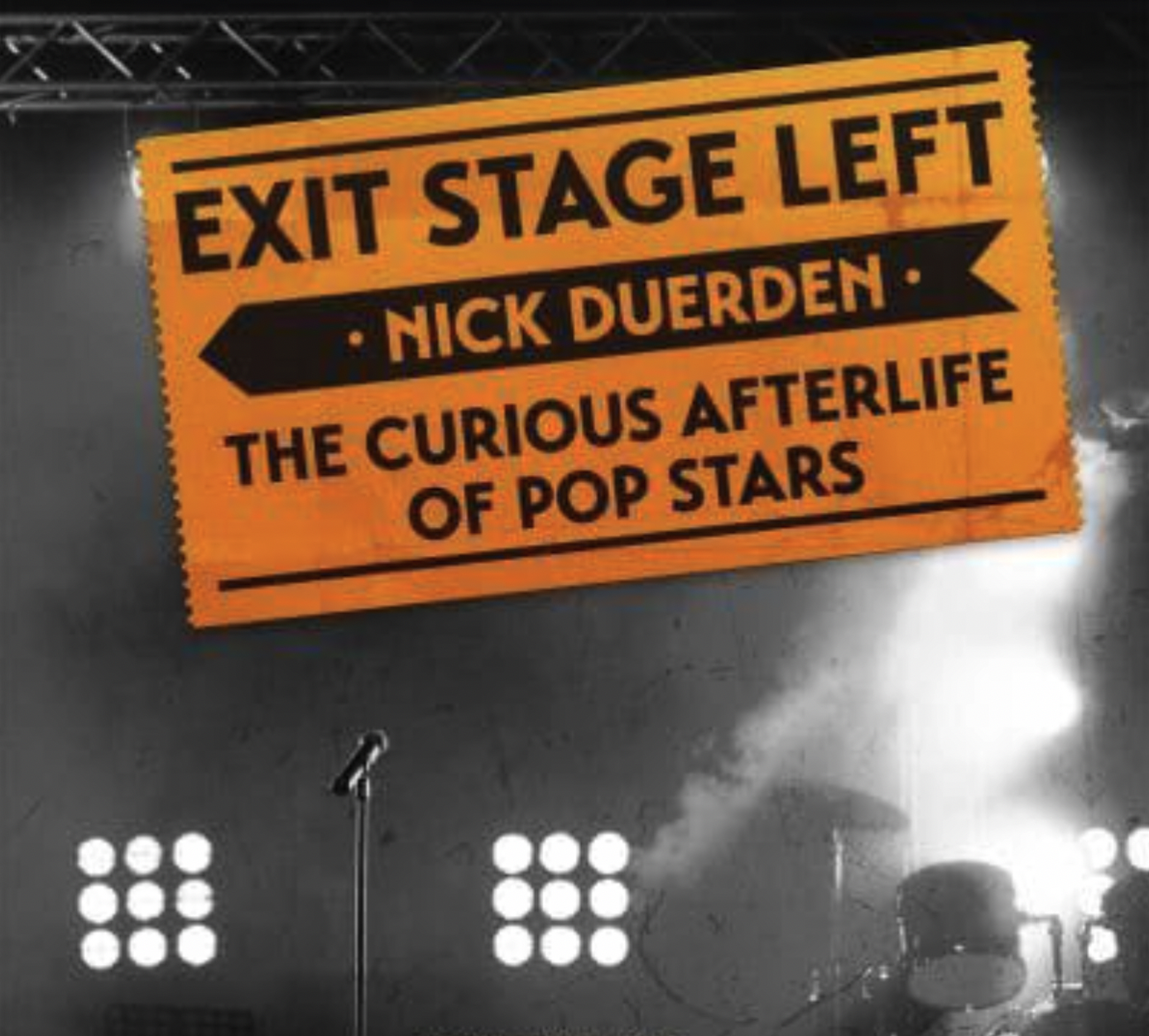
BOOK REVIEW: EXIT STAGE LEFT by Nick Duerden
Ever wonder what happens to Pop Stars when the spotlight moves on to the Next Big Thing? British writer Nick Duerden interviewed dozens of Pop Stars, from famous names like Joe Jackson and Bob Geldof to lesser acts and One-Hit Wonders. Here's what we thought of the book at Nu Shooz HQ.

Ever wonder what happens to Pop Stars when the spotlight moves on to the Next Big Thing?
British writer Nick Duerden interviewed dozens of Pop Stars, from famous names like Joe Jackson and Bob Geldof to lesser acts and One-Hit Wonders.
Their reactions to the 'Dying of the Light' run the gamut from drug overdose to domesticity, from moving on to making music for the pure pleasure of the craft.
For us at Nu Shooz HQ, the book was like a weekend therapy session. "Hey, we made it out of that experience with our lives and relationships intact!" We especially recommend "Exit Stage Left" to anyone pursuing a career in music and anyone who made it out alive.
We heard about this book in Austin Kleon's excellent Newsletter. He's the New York Times Best-Selling author of three books about the Artist's Life; "Steal Like an Artist," "Keep Going," and "Show Your Work."

Happy Nu Year! Inspiration & Uplift
Four of the best words in Western Literature are, "This Too Shall Pass" Think of all the things that have come and gone; The Great Plague, The Spanish Inquisition, Joe McCarthy, Shoulder Pads! THIS TOO SHALL PASS. So, what do we do while we wait for this moment to pass? What inspires us to keep going? We've got a few things to share with you that we hope will lift your spirits.

Photo by Kristopher Roller on Unsplash
Dear Friends,
Four of the best words in Western Literature are, "This Too Shall Pass" Think of all the things that have come and gone; The Great Plague, The Spanish Inquisition, Joe McCarthy, Shoulder Pads! THIS TOO SHALL PASS. We hope this email finds you well and happy as we turn another page on the calendar, and our tiny globe spins on and on. Happy New Year, and Thanks for keeping the Music alive.
Until next time, be well!
Valerie and John
So, what do we do while we wait
for this moment to pass?
What inspires us to keep going?
We've got a few things to share with you that we hope will lift your spirits.
One of the things that inspires us most are the children coming up in this uncertain world. Their courage and determination are remarkable. In honor of them and Martin Luther King Day, above is a trailer for a movie that's a must-see:
"Every year in Oakland, CA, hundreds of pre-K through 12th grade students compete in the Martin Luther King Oratorical Festival, performing a mix of published and original poetry and speeches. This documentary chronicles the months leading up to the 40th annual festival, as schools across the city send their top-placing students to compete. It is a portrait of passionate young people raising their voices about issues they care about – social justice, immigration and more – and of a community that celebrates them."
You can rent or purchase the movie HERE on Amazon.
Are you a Creative struggling to Keep Going?
One of our favorite authors and creatives, Austin Kleon, has a book for that!
Check out a preview of it below.
You can purchase copies on Amazon, Barnes and Noble, IndieBound, or iBooks
or find it online at your local library. (Download the Libby app,
connect your library card, and you can read it for free!)
Here's some more info about what's in the book from Austin himself:
"The world is crazy. Creative work is hard. How do you keep going?
In my previous books — the New York Times bestsellers Steal Like An Artist and Show Your Work! — I showed readers how to steal their way to a more creative life and then share their creativity to get discovered. In Keep Going, I show you 10 ways to stay creative, focused, and true to yourself:
1. Every day is Groundhog Day.
2. Build a bliss station.
3. Forget the noun, do the verb.
4. Make gifts.
5. The ordinary + extra attention = the extraordinary
6. Slay the art monsters.
7. You’re allowed to change your mind.
8. When in doubt, tidy up.
9. Demons hate fresh air.
10. Plant your garden.
Whether you’re burned out, starting out, starting over, or wildly successful,
Keep Going will help you stay on the path to more creative work."
Last but not least is a project David Byrnes (Talking Heads) started a few years ago to gather and spread the good news happening in the world through a website called Reasons To Be Cheerful. In the bleak landscape of 24/7 bad news, Reasons To Be Cheerful is a bright light.
Here's a bit about the project from the website About page:
Reasons to be Cheerful
is a non-profit editorial project
that is tonic for tumultuous times.
We tell stories that reveal that there are, in fact, a surprising number of reasons to feel cheerful.
Many of these reasons come in the form of smart, proven,
replicable solutions to the world’s most pressing problems.
We’re here to tell you about some of them.
Through sharp reporting, our stories balance a sense of healthy optimism
with journalistic rigor and find cause for hope. We are part magazine,
part therapy session, part blueprint for a better world.
Reasons to be Cheerful was founded by artist and musician David Byrne, who believes in the power of approaching the world with curiosity—in art, in music, in collaboration, and in life. Under the banner of Byrne’s non-profit organization, Arbutus, Reasons to be Cheerful embodies this sensibility, applying it now to the future of our world. Through stories of hope, rooted in evidence, Reasons to be Cheerful aims to inspire us all to be curious about how the world can be better, and to ask ourselves how we can be part of that change.
Find our latest newsletter below!
Search The Blog….

![Welcome to your summer. Yes, it's finally here! And it's the 46th anniversary of the very first NuShooz gig. [Colonel Summer's Park, Portland, Oregon, June 21st, 1979.] What a different world that was; pre-internet, no smartphones or smart toasters,](https://images.squarespace-cdn.com/content/v1/54cee645e4b01fa0f0bfc5f9/1772327896063-IIMMIJOZCTP00HOVTU9D/image-asset.jpeg)