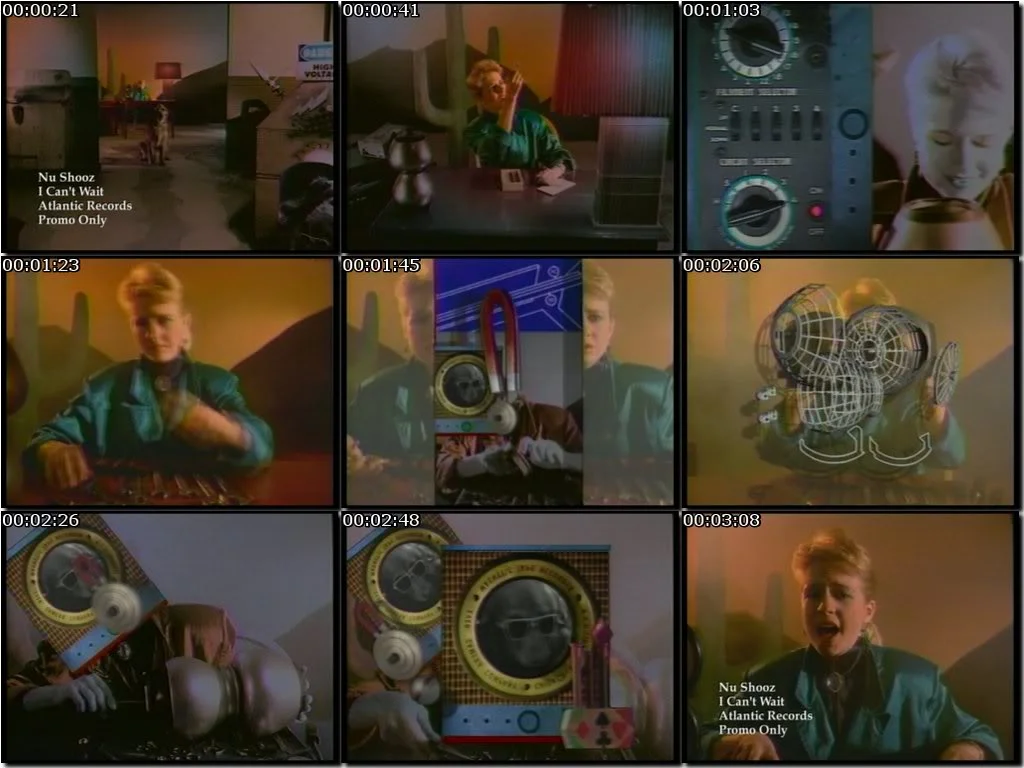
Nu Shooz and director Jim Blashfield talk about “I Can’t Wait”
When citing examples of music video directors with signature looks, names like Anton Corbijn or Matt Mahurin jump out, but the unfortunately overlooked genius in this club must be Jim Blashfield. Creating a trademark visual sensibility with just a handful of videos, the Oregon native created dreamlike fantasies with a cut-out xerographic animation style that reveals a gentle magic hiding the ordinary — strangely devilish garage-sale travelogues, if you will. Jim’s artisan videos, which embrace both texture and perspective, include Talking Heads’ “And She Was,” Paul Simon’s “Boy in the Bubble,” Tears for Fears’ “Sowing the Seeds of Love” and Michael Jackson’s wildly self-effacing “Leave Me Alone.” His most visually-trippy grab bag of kitchen sink mischief, though, is his clip for Nu Shooz’s “I Can’t Wait” from their album Poolside. The video he created for his fellow Portlanders, Valerie Day and John Smith, helped propel the duo’s inescapably catchy hit into pop history — and also into the still-curious minds of video music fans everywhere.
I spoke to Jim recently about his career, and he shared his experience on creating this amazing piece of filmmaking:
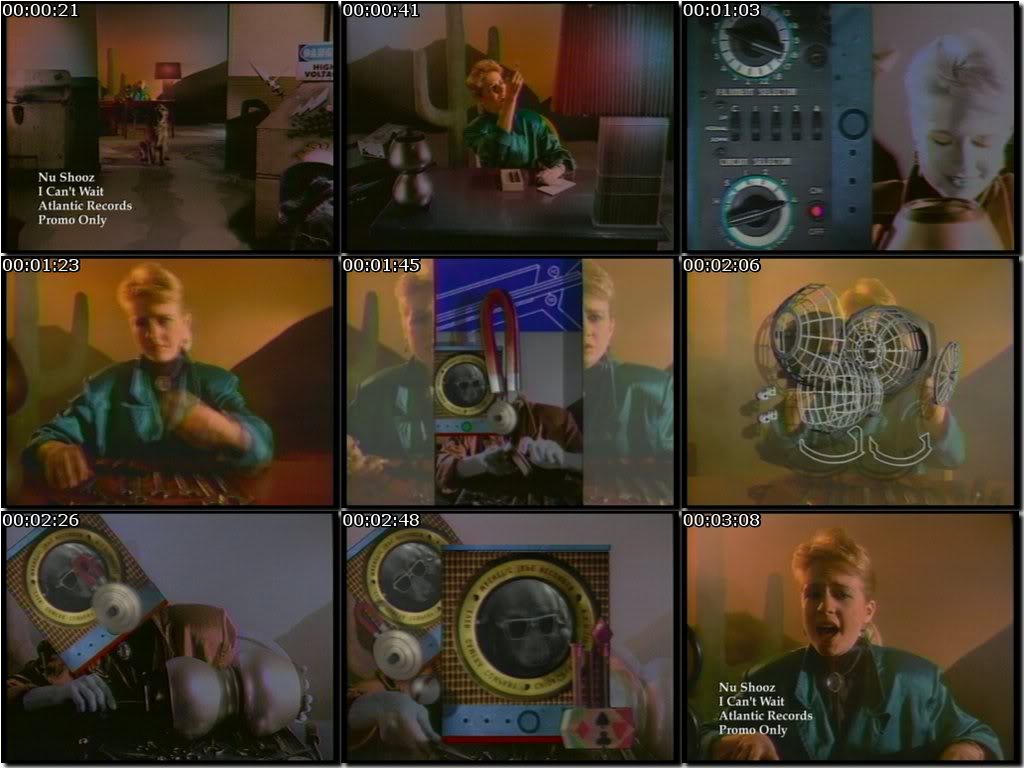
When citing examples of music video directors with signature looks, names like Anton Corbijn or Matt Mahurin jump out, but the unfortunately overlooked genius in this club must be Jim Blashfield. Creating a trademark visual sensibility with just a handful of videos, the Oregon native created dreamlike fantasies with a cut-out xerographic animation style that reveals a gentle magic hiding the ordinary — strangely devilish garage-sale travelogues, if you will. Jim’s artisan videos, which embrace both texture and perspective, include Talking Heads’ “And She Was,” Paul Simon’s “Boy in the Bubble,” Tears for Fears’ “Sowing the Seeds of Love” and Michael Jackson’s wildly self-effacing “Leave Me Alone.” His most visually-trippy grab bag of kitchen sink mischief, though, is his clip for Nu Shooz’s “I Can’t Wait” from their album Poolside. The video he created for his fellow Portlanders, Valerie Day and John Smith, helped propel the duo’s inescapably catchy hit into pop history — and also into the still-curious minds of video music fans everywhere.
I spoke to Jim recently about his career, and he shared his experience on creating this amazing piece of filmmaking:
“I explained that I wanted to improvise it. I didn’t want to plan it at all. I wanted the experience of just making it up from what was around when we got to the studio. The morning of the shoot, I loaded my kitchen table and chair and lamp into my car along with some biology slides and a coffee maker and some kind of cigar box and headed over to the stage. I rummaged around among the props there and found some canvas and some walls from a commercial and some fake cactuses. I went upstairs where the band and the crew were assembled– we had a good and very professional crew, as you can tell from looking at the images– and told them I would be back in 10 minutes with instructions about setting up for the first shot, about which I had no idea whatsoever. I rummaged around in people’s offices and borrowed a few other items which looked promising. I went upstairs and said we were doing a video that took place in the desert, and set people about creating that. It seemed like we needed something in front of the green walls, so the video editor went down the street and came back with a dumpster, and rigged a way to make the lid go up and down with fishing line. I recalled that my friends who were on vacation had a great looking dog house for their dog Buster, and some people went there and stole it. We called up a friend with an obedient dog who would stay when asked, and he brought his pooch over. Somebody else got a bunch of tools out of the trunk of their car.”
“After the shoot the next step was a trip to Seattle to get the footage transferred and do strange things to some of it. Then, for post production, a trip to the thrift store and the corner grocery, returning with every other little gadget and doo-dah you see on the screen. The video editor was Mike Quinn who subsequently did the high-degree-of-difficulty video editing for my videos for Paul Simon, Peter Gabriel and others. During editing I called my friend Roger Kukes, the animator, and asked him if I could use part of his animated film ‘Up’ for the ending of the video where Valerie opens the little box and all the wiggly images come out, revealing all knowledge known to humankind. I recall that the opening scene with the Banana and souvenir totem pole dropping onto a piece of metal with holes in it took about 8 hours to composite, and was completed while I slept on the couch in the editing room. The scene where the image of the dog watching the golf ballish thing swings in and unceremoniously lands on Valerie’s head– and where it remains for longer than might be considered, strictly speaking, necessary– is there because it made me laugh when we tried it in post and was left in because nobody said I couldn’t. We had a take in which the guy with the smoke machine walks through in the background waving it around while Valerie is singing, but I left that out, due to some conservative impulse on my part, which I regret.”
Exclusively for The Golden Age of Music Video, Valerie Day and John Smith collectively answered a few questions about the video by email:
Q: How did you and Jim find each other?
A: Jim Blashfield was a local film maker/artist working in our hometown, Portland Oregon. We knew him first as a cartoonist, His drawings appeared in the local ‘free press.’ By the time the Shooz signed to Atlantic he’d become a world class video director, and his stuff was unique. It seemed like a good fit, and as it turned out, it was. His ‘I Can’t Wait’ video is our favorite of the three we made.
Q: How was working with Jim during the shoot? He said you really went with the flow.
A: The whole shoot was a swirl of madness. We had 48 hours between coming off the road and a vacation in Mexico. Jim improvised the whole thing, grabbing up objects like plastic sharks and samovars and somehow working them into the shoot.
Q: What do you recall as a highlight from the shoot?
A: A few days ago we were talking to a friend who worked on that shoot. She says she remembered Valerie sitting on a chair atop a spinning platform. They shot hours of this spinning thing. Jim kept saying ‘Shoot it one more time.’ None of that footage made the final cut.
Q: After I spoke to Jim, I realized that most of it was done on the fly and there’s no real subtext, other than Valerie plays a scientist examining things and trying get the answer to “tell me what it’s all about”. When people ask you to explain parts of the video, do you find that irksome or amusing?
A: We prefer to let people come up with their own interpretation. Carl Jung’s work with the unconscious suggests that everything in our heads is connected, all our preferences and prejudices, what we like and what we don’t. Somehow the random imagery in the “I Can’t Wait” video ended up saying exactly what we wanted it to say.
Q: Jim said, “If viewers look closely they may notice that happiness seems to be represented as a shark found lurking in a coffee pot, a metaphor which is certainly worth considering, if you ask me.” What do you think about that?
A: In the hands of a lesser director we might have ended up with a melancholy/needy girl waiting by the phone. Not Jim. It wasn’t that we discussed our vision so much as he was just as psychedelic as we were.
Q: What did you think the first time you saw it, and what do you think when you see it now?
A: MTV was a cultural revolution. In some ways it ruined music, in some ways it added a new dimension. At the time it was just thrilling to be a part of it, to know they were watching us in Cleveland…and Brazil. When we see it now, it still holds up as a perfect piece of art, one that represents Nu Shooz exactly how we wanted it to be seen.
TOP 5 THINGS TO DO WHILE RECOVERING FROM AN APPENDECTOMY
I had a pretty mellow Father's Day, all things considered. Got to spend the whole day in a comfortable chair, reading. It would have been perfect except that the chair was in the waiting room at St. Vincent Hospital. Valerie woke up that morning in severe pain. By noon it wasn't getting any better so we went to the Emergency Room. Within the hour she was under the knife, being parted from her APPENDIX!
The Appendix is like the 'Vice President of Internal Organs,' [i.e.; no known function] So as I sat reading in Father's Day splendor, Valerie's Appendix was being impeached. The offending organ went quietly, stating only that it "wanted to spend more time with family."
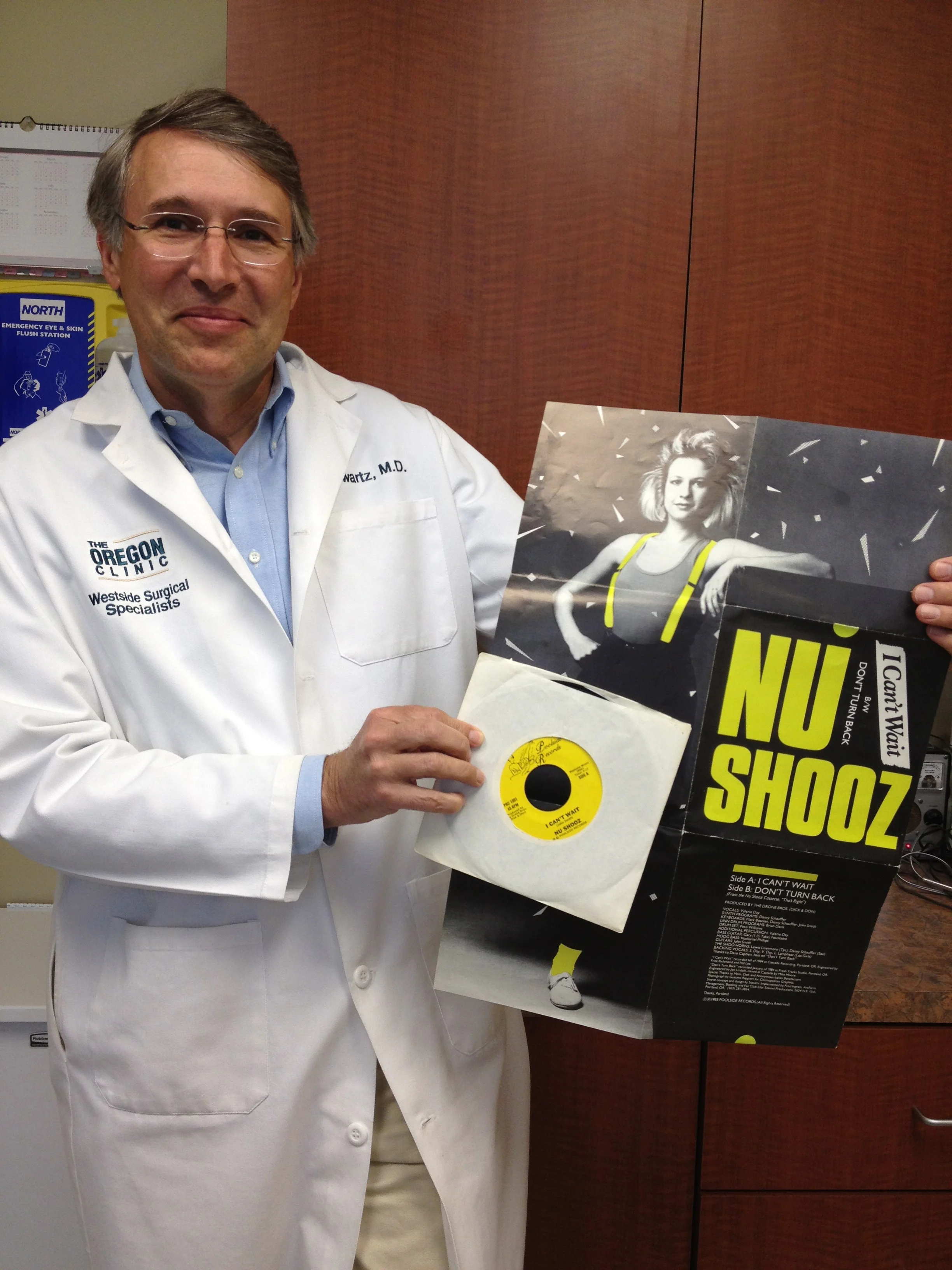
As luck would have it, the surgeon was a Nu Shooz fan. As they wheeled her into surgery, he asked "Are you the Valerie Day?" Turns out he still had his old 45.
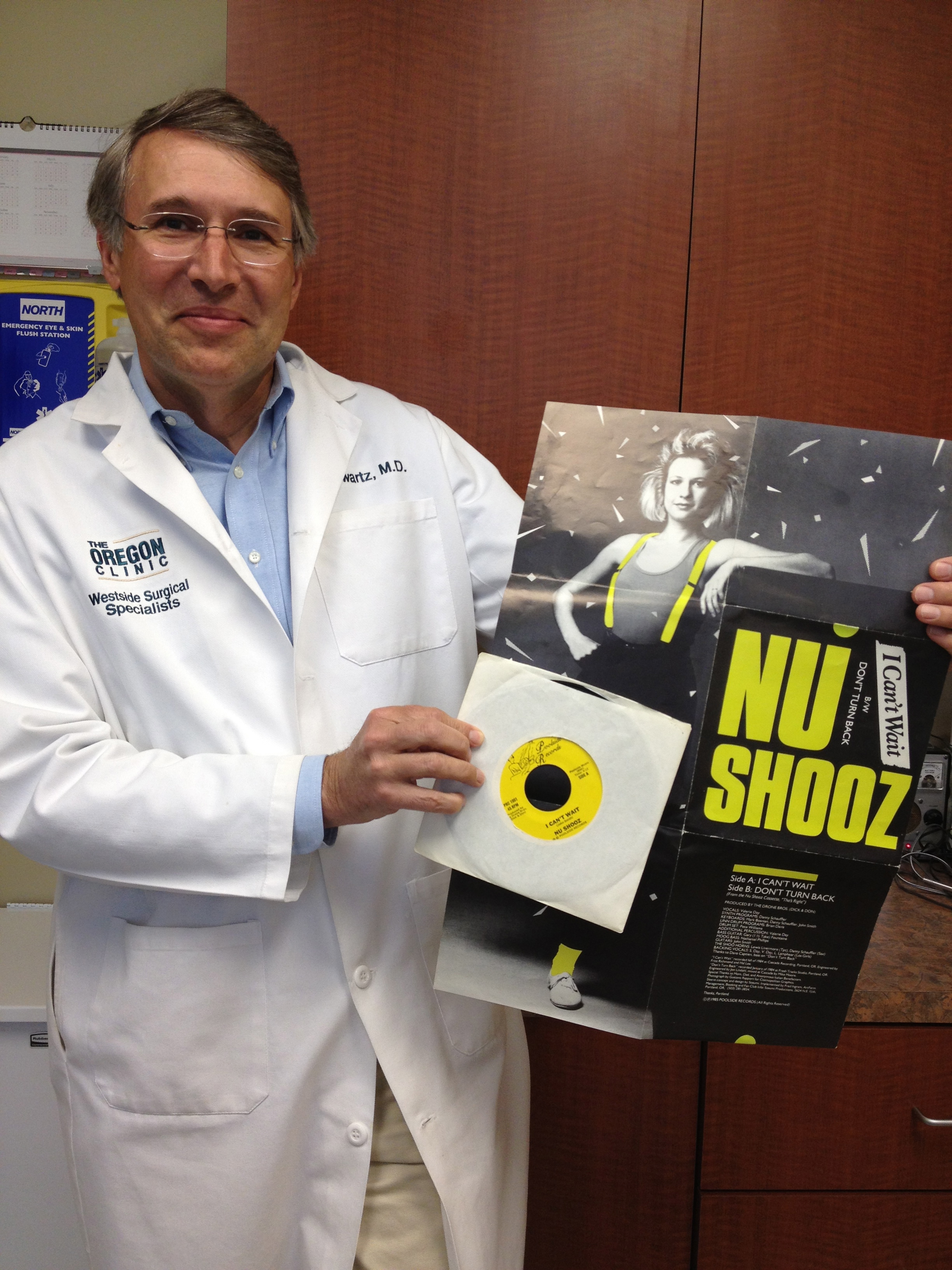
I had a pretty mellow Father's Day, all things considered. Got to spend the whole day in a comfortable chair, reading. It would have been perfect except that the chair was in the waiting room at St. Vincent Hospital. Valerie woke up that morning in severe pain. By noon it wasn't getting any better so we went to the Emergency Room. Within the hour she was under the knife, being parted from her APPENDIX!
The Appendix is like the 'Vice President of Internal Organs,' [i.e.; no known function] So as I sat reading in Father's Day splendor, Valerie's Appendix was being impeached. The offending organ went quietly, stating only that it "wanted to spend more time with family."
As luck would have it, the surgeon was a Nu Shooz fan. As they wheeled her into surgery, he asked "Are you the Valerie Day?" Turns out he still had his old 45.
We ended up having a great time at the hospital the next day. Her room had a lovely view of the hills above Portland, and the room service was excellent. "Would you like another pain pill with those fries?" We ended up staying all afternoon. While we were soaking up the local hospitality, Valerie came up with this list of "Top 5 Things To Do While Recovering From An Appendectomy " - John
And here's the list...
TOP 5 THINGS TO DO WHEN RECOVERING FROM AN APPENDECTOMY
(Not neccessarily in this order:)
1) Play Words w/Friends Even if you're too gorked out on pain meds to actually find the PERFECT Word (for the most points), WWF is great exercise for the mind and you can still feel connected via messaging with your friends.
2) Watch "The IT Crowd" on Netflix Warning! Practice laughing without moving your abdomen FIRST. This British comedy series HURTS it's so funny!
3) Meditate Get some HEADSPACE. Find inspiration on meditation here or on www.tricycle.com
4) Eat popsicles 'Nuff said
5) Check out the latest news, article, book, video on BRAIN PICKINGS Brain Pickings is…" is your LEGO treasure chest, full of pieces across art, design, science, technology, philosophy, history, politics, psychology, sociology, ecology, anthropology, you-name-itology." I could get lost on this website for decades!http://www.brainpickings.org/
5) Kill some time on Facebook After almost a year of treatments for breast cancer, I have to say that - even with all it's faults - FB can be a lifesaver when you're spending a lot of your life in bed. You can live vicariously, be distracted in awesome ways from how bad you feel, keep in touch with those you care about and who care about you, and, if you share what you're going through, be uplifted and supported in your recovery. Thank you FRIENDS!
OK. There were actually six things. But who's counting!
KUNG PAO & DONUTS
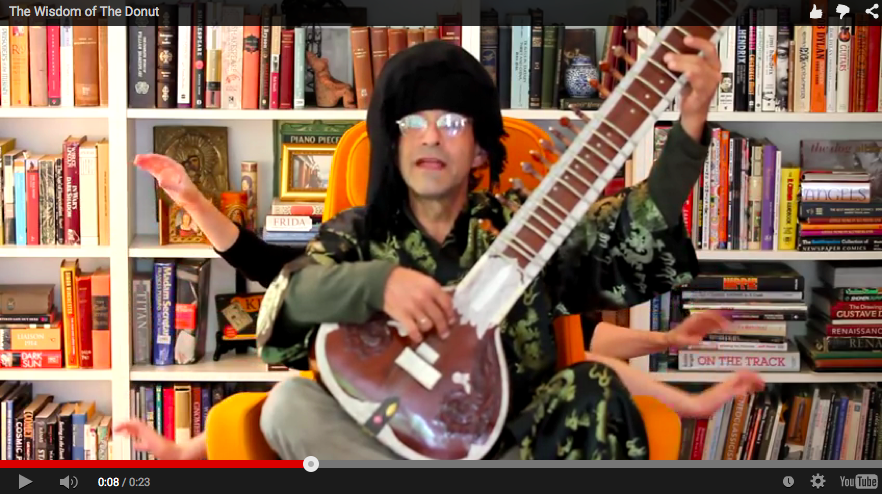
This year, by supernatural coincidence, National Donut Day came in the same week as the release of the NU SHOOZ latest album, Kung Pao Kitchen. We feel that this harmonic convergence deserves some quiet reflection…
TODAY’S MEDITATION:
What does the latest Nu Shooz release, Kung Pao Kitchen, have in common with a donut?
For starters, both have a hole in the center. While we could go deep into the meaning of that Negative Space, it’s the part we can see where the richness lies. This richness can only be experienced directly. Bite into the donut. Dive into the music.
Only then is the true flavor to be revealed.
This year, by supernatural coincidence, National Donut Day came in the same week as the release of the NU SHOOZ latest album, Kung Pao Kitchen. We feel that this harmonic convergence deserves some quiet reflection…
TODAY’S MEDITATION:
What does the latest Nu Shooz release, Kung Pao Kitchen, have in common with a donut?
For starters, both have a hole in the center. While we could go deep into the meaning of that Negative Space, it’s the part we can see where the richness lies. This richness can only be experienced directly. Bite into the donut. Dive into the music.
Only then is the true flavor to be revealed.
Both the donut and Kung Pao Kitchen contain mood-enhancing qualities. Who can stay in a bad mood when biting into a fresh Maple Bar or a classic Old-Fashioned? And who can resist the pleasing thump and bleat of 80s-heavy Nu Shooz beats?
Of course, there are differences. We don’t recommend dipping the album in coffee, and we don’t recommend putting a donut into your CD player. But Nu Shooz music and fresh donuts share one more important trait: Both are common pleasures that make us glad to be alive.
And both are worthy subjects for meditation.
Maurice Sendak (1928-2012)
Maurice Sendak died this last Tuesday.
Of all the famous people we met during the NU SHOOZ years, he was the one I was most excited about. I have a picture taken with him in the green room at Good Morning America. Our appearance never aired due to some crisis in the World, but it didn’t matter. I got to meet the guy that wrote ‘Where the Wild Things Are.’ Maurice Sendak gave us a masterpiece that will live forever. Meeting him was the thrill of a lifetime. Martin Scorsese said the best art tells us about what it’s like to be human. ‘Where The Wild Things Are’ does that and more. We are all MAX. Thank you Maurice Sendak.
Go where the Wild Things go.


The Sweet Middle
It’s a frightening time to be an artist. On one hand we have technological capabilities undreamed of thirty years ago. On the other, our lives are so full of distractions it’s a wonder anyone can do anything. Worst of all, it’s impossible to get anyone’s attention these days, not without a million dollar advertising blitz. Open up the paper and there are thousands of bands, art exhibits, films, dance performances, a tsunami of artists.
Welcome to the Post-Modern world.
In the midst of this apocalyptic scenario, the conversation around our house lately has been ‘Why do art at all?’
Here’s what we came up with:

by John Smith
It’s a frightening time to be an artist. On one hand we have technological capabilities undreamed of thirty years ago. On the other, our lives are so full of distractions it’s a wonder anyone can do anything. Worst of all, it’s impossible to get anyone’s attention these days, not without a million dollar advertising blitz. Open up the paper and there are thousands of bands, art exhibits, films, dance performances, a tsunami of artists.
Welcome to the Post-Modern world.
One of the characteristics of Post-Modernism is that all art will be mashed together. The Mona Lisa and Venus DeMilo are Photoshopped into a ’58 Chevy Belair. They’re driving across the surface of the moon while listening to a hybrid of Flatt and Scruggs, Grandmaster Flash, and an Indonesian Monkey Chant.
You get the idea.
In Post-Modernism no one piece of art is more important than any other. Pure genres are dead. Long live the mash-up.
In the midst of this apocalyptic scenario, the conversation around our house lately has been ‘Why do art at all?’
Here’s what we came up with:
1.) DOING SOMETHING IS BETTER THAN DOING NOTHING.
Sure, doing nothing has its place, say on a Zen retreat. Generally though, doing nothing is boring. Nature abhors a vacuum, and our own natures abhor it most of all. Time is not constant. The observer influences the result. (Sorry for the oversimplification of the Heisenberg Uncertainty Principle.) When you’re truly engaged, time flies by. There aren’t enough hours in a day. Compare that to its opposite, say the last period of the day before school gets out. We crave engagement, and engagement sets us free.
2.) ART FEEDS THE MIND BODY & SPIRIT
Ask anyone with a career in the arts and they’ll tell you they have never stopped striving. That’s because no matter what your chosen medium is, there’s always more to learn. Michaelangelo and Leonardo, two of the greatest artists in human history never reached a point where they felt they’d arrived. The great cellist Pablo Casals was still perfecting his technique at age ninety.
That means there’s a lifetime of things to work on, a lifetime of food for the human spirit.
3.) ART IS FUN
Even if no one ever hears your song or watches your movie or offers you three million dollars for your finger painting, the act of creation FEELS GOOD. It’s like meditation and sports all rolled into one. I’m no scientist but I’m sure there are measurable effects when a person is creating, changes in heart rate and respiration, different parts of the brain lighting up.
4.) THE SWEET MIDDLE
Now we come to my personal favorite, what I call The Sweet Middle. Imagine a hamburger, not a cardboard one made by a King or a Jack or a Clown. A real honest-to-God American hamburger.
What’s the best part?
It’s not around the edges of the bun. It’s the middle. Think about it. That’s where the rare meat is, where it’s mixing with the condiments, becoming more than the sum of its parts.
The same is true with making art.
The best part isn’t the beginning of a project, though the initial idea may be exciting. (Some people never get past the idea.) It’s not when it’s finished. A lot of artists I know lose interest in their creations once they’re complete. They’re already on to the next thing.
The best part of a project is when it’s up and running but it isn’t finished yet. It exists, but still contains possibility. In other words, it’s still in motion.
That’s the best part of the creative process, the Sweet Middle. After lots of soul searching we realized that’s a good enough reason to keep making stuff, even in our crazy Post-Modern world.
Don't Push The River: Movement Is Life
Thirty million years ago we were writing songs for the fifth Nu Shooz album. It was a struggle. The label hated everything we handed in. We began to doubt ourselves. But I’m proud to say we didn’t stop.
Movement is life, and by moving, we know we’re alive.
Sink or swim, baby.

The continuing saga of Kung Pao Kitchen.
The I-Ching says this:
"IT FURTHERS ONE TO CROSS THE GREAT WATER."
What does that mean?
It means that movement is life.
We try things. We succeed. We fail. And all our endeavors further us in some way.
Thirty million years ago we were writing songs for the fifth Nu Shooz album. It was a struggle. The label hated everything we handed in. We began to doubt ourselves. But I’m proud to say we didn’t stop.
Movement is life, and by moving, we know we’re alive.
Sink or swim, baby.
Sometimes the river fights back. Strong currents want to drown us. If we struggle, we only get tired. (There’s truth in the metaphor I’m beating to death here.)
We worked hard on the songs. I suppose I could use something about rowing against the current. In the end, the label decided to shelve the record.
So now it’s now.
We dusted off the tapes and hey, they’re pretty cool. We spent the next four months scraping them into little sandcastles, adding stuff, taking stuff out. It’s obsessive work…fun work.
"The album will be done in five more days!" Then…Blamp!
The computer is dead.
This is not just a computer. It’s a Mac Pro with a Pro-Tools HDIII system running the new Version 9 software. Only guys with really thick glasses know how to make this thing go.
"Don’t worry, no data was lost."
While this is going on, we received news that a key member of the band was diagnosed with cancer.
This put everything in a different light. Sometimes it feels ridiculous to work on music in the face of grim reality. And then...sometimes it feels like the only thing left to do.
Keep on moving.
The computer is running again.
The cancer has been stared directly in the eye. The Doctor said, “You’ll have to find something else to die of.”
Yesterday we opened up the recovered Kung Pao Kitchen tracks and listened to them. Valerie said she thought horns would be good on one of the songs. After she said that, other songs sprouted horns. It’s like the whole record went from three dimensions to four! Nothing was lost.
While we were busy fighting the tides, they were changing us, and changing the landscape around us. The roiling waters changed us in ways we couldn’t guess.
It’s going to be a great record, a different record.
We try things. We succeed. We fail.
And all our endeavors further us in some way.
Movement is life.
- JRS
9/1/11
Russ' Retro Rock Interviews The Shooz
We recently christened the new 80s feature on Russ' Retro Rock! Even though some of these questions have been asked before, we discover something new about ourselves every time we answer them...and we hope you do too! Enjoy.
We recently christened the new 80s feature on Russ' Retro Rock! Even though some of these questions have been asked before, we discover something new about ourselves every time we answer them...and we hope you do too! Enjoy.
--------
Swerve Magazine: Thanks for taking the time to do this interview. Incidentally, you are the first artists to be interviewed by us for our new monthly 80s feature.
John Smith: What was the question? Just kidding. We’re honored that our 80s work has become a permanent part of the culture, and in a way, a sort of brand name. The 80s were a great time to be young and alive and to have a band. We actually made a living with a nine-piece band for seven years before Atlantic signed us. Not so sure we could do that now.
SM: I caught a clip somewhere online of a show from the 80s that described you and your husband as hippies when you first met. Were/are you guys really hippies?
JS: We met at a hippie commune called ‘The First Cosmic Bank of Divine Economy’ or ‘cosmic bank’ for short. It wasn’t a cult or anything, but we were all teenagers, reading Yogananda, and Castaneda, Herman Hesse and B.F. Skinner. Valerie was the responsible one. She knew how to balance a checkbook. We called her the ‘hippie with a checkbook.’ I always embraced hippie values musically. We came up in the era where Coltrane could fill up four sides of an LP with one song! It was sort of the precursor to the extended dance remix! I wanted to mix the angry psychedelia of Hendrix with the magic paisley harmonic carpet-bombing of ‘Trane and Charlie Parker. Of course in the end, Nu Shooz didn’t come out anything like that.
SM: When did you guys form Nu Shooz? How did the name of the band come about?
JS: You know, when I was young I used to practice being interviewed. I thought I’d be all evanescent and mystical like Hendrix. ‘Yeah, dig brother…no buttons to push…didn’t even rain.’ Or maybe I’d play with people’s heads like Bob Dylan. (“I think of myself as a song-and-dance man.”) When we finally got somewhere in show business, we got asked the same three questions over and over:
A.) How did you get the name of the Band?
B.) What’s it like to be married and in a band.
C.) [...Something something....] ‘I Can’t Wait.’
So you see, the parameters of Modern Show Business don’t allow for any of the shenanigans Dylan and Hendrix used to get away with. No beat poetry,just the facts. I guess we’re living in a non-poetic age.
But to answer the question…
Valerie and I played in Latin and African bands in the late 70s. This was before they called it ‘World Music.’ I arranged and played piano for a salsa band called Felicidades. Valerie played congas and African drums with Ghanaian master drummer Obo Addy. By 78 Felicidades was breaking up. I took a trip to New York and had an artistic epiphany there. I’m not from Cuba or Puerto Rico. I’m an American. I want to do ‘American Music.’ There was this mystic happening, a God thing. I found an abandoned Motown songbook on top of a battered upright piano, sat down and started playing through it.
So, by the time I got back to Portland I knew I wanted to do a soul band.
Nu Shooz was started by me and Larry Haggin, the front man for Felicidades. We had an upcoming gig at a park, and needed a name for the group. This was in the spring of 1979. Larry and I were in the kitchen of the house where we practiced. There was this contact paper on the walls printed like an 1890s newspaper. We looked over at the same time and saw some shoes…those buttonhole shoes.
“Hey, we could be the Shoes!”
The rest is…um…History.
For years afterward I walked around thinking, I wish we’d spent like, five more minutes on it and come up with something cooler, something like…Megadeth. Now, after thirty-three years I have to admit it’s grown on me. Oh yeah, and the spelling evolved over time. I give credit for the spelling to Jim Hogan, our original bass player.
I recall him saying, ‘Spell it with a ‘Z,’ it looks more rock.’
SM: How did your sound and style come about? Was it basically doing what was the sign of the time?
JS: Sign of the time? Hah! We were the Counter-Reformation! Let me back up. I knew I wanted to do a soul band with horns. After Felicidades, I always had to have horns. But the first Nu Shooz band was just two guitars, bass, and drums. And it was a democracy. One guy wanted to do Eric Clapton. Someone (who shall now be named) brought in ‘Silly Love Songs’ by Paul McCartney. It was a mess. It taught me the value of Benevolent Dictatorship. There has to be one hand on the tiller. The Shoo-Horns came on in 1980, four horns: trumpet, tenor, ‘bone, and ‘Bari, a big fat sound. Valerie joined in '81 after a year in music school. By then we were one of the happening bands in Portland, Oregon.
Now back to the Counter-Reformation thing. When I was in New York in 78, I saw the early punk movement happening and I hated it. Punk just sounded stupid to my ears, stupid and irritating. I loved the heavy Philly-soul production of Gamble & Huff, with the horns and strings and congas. To me that sound had dignity. I liked disco, but disco was devolving into all those bad Casablanca records, ‘Disco Beethoven’s Fifth’ and all that crap. So then came another epiphany. If I hated punk and loved disco and Philly soul and Tower of Power and Earth Wind and Fire, maybe there were other people out there like me.
The answer was yes.
So, Nu Shooz in a big way was me shooting back at the Punk Invasion. But beside that, I just dug arranging…those big sheets of music paper, the math and art and science of it. In the mid-70s, I started listening to arrangers like Toshiko Akiyoshi and Papo Luca. So, another side of the story was that I wanted a band like Miles Davis had on ‘Birth of the Cool,’ nine horns, a jazz laboratory. ‘We’ll play pop music on the side, then write these beautiful charts…’ It didn’t turn out that way.
SM: ‘I Can’t Wait’ (ICW) received regional airplay in your native Oregon. At the time, how cool was it that your song was on the airwaves? Did you ever fathom that it would blow up into a worldwide hit and one of the defining songs of the decade?
JS: Ask anyone and they’ll tell you it’s impossible to know whether a song is a hit or not. All I know is, of all the songs we were recording in the winter of ’84 that one sounded the most real, the most like an actual record. Then it took six months to make it work in the studio.
Valerie Day: I’ll never forget the first time I heard it on the radio. It was April and the sun was out - a miraculous sunny spring day in Portland, OR. I was in my little 79’ Toyota Corolla station wagon driving up Weidler Street. My radio was dialed to Z100 – the station that had first played the song and recently put it into regular rotation (a miracle for an unsigned band – but that’s another story!). And then there it was. I cranked the volume up and started singing along. Then it hit me - I was actually singing with myself on the radio! I rolled down the window and wanted to shout it to the world – hey – that’s my voice! That’s our band! That’s our song! It was an incredible feeling. But I never dreamed that I would become - as you put it – one of the defining songs of the decade. Miraculous.
SM: How did the remix of the song, the version that the world knows, come about?
VD: We had a regional hit with the song first, but couldn’t get arrested when it came to getting a label to sign us. Even though we were getting all kinds of airplay on radio throughout the Pacific NW, they thought it was a fluke that the songs success wouldn’t translate to other markets. Warner gave us a demo deal but then turned us down saying “We already have Madonna.”
While we were busy being turned down by all the majors, a DJ label called Hot Trax approached us about putting ‘ICW’ on a 12” going out to club DJ’s. We said sure. Long story short, that record was found in an import bin in Holland by a remix artist named Peter Slaghuis. His version (with the infamous emulator chirpy sound on the front) came back to the U.S. as a Dutch import and was found in a NYC dance club by a young guy named Bruce Carbon who had just started working in the Dance department at Atlantic Records. (Thanks Bruce!)
SM: You guys were up for a Grammy the year ‘ I Can’t Wait’ came out (in 1987, for Best New Artist). How cool was that? Were you present at the awards show and, if so, did you take a look around at all the artists there that night and think, “Wow.”
VD: That was an amazing moment. Sitting in that auditorium in L.A. with Whitney Houston, Bonnie Raitt, Janet Jackson…it was too much. We had a feeling Bruce Hornsby was going to win the award, (which he did) but there was still that pregnant pause when the envelope was being opened that I wondered if my antiperspirant would hold up to the strain!
SM: Did everything hit you too fast…in terms of popularity, promos, touring etc. after the releases of ‘I Can’t Wait’ and ‘Point of No Return?” How did you guys deal with sudden fame?
JS: Um…We played for seven years before we ever got near a record label, so when the fame thing happened, we could definitely get up and play. Then we were too busy for it to really sink in. We took the band on the road and played seventy cities in seventy-three days. On our three days off we did laundry.
SM: Who did you guys tour with in the 80s? Any interesting stories?
VD: We toured with Morris Day and the Time, The Jets, Billy Ocean, The Fat Boys, Tina Turner, The Pointer Sisters…speaking of which, have you ever seen “This Is Spinal Tap”? I think pretty much everything that happened in to the band in that movie happened to ours except for the getting stuck in the egg bit.
When we opened for the Pointer Sisters the whole band got lost in the bowels of the auditorium we were playing in just as we were about to go on. The voice of the announcer “And now ladies and gentlemen…” was bouncing off the pipes as we raced around trying to find our way to the stage. We made it, but the pause was VERY pregnant between the announcement and our rather rushed entrance.
SM: What was the cause of Nu Shooz falling back into relative obscurity as the 80s wound down, even though you put out several more albums? Was it because of the changing industry, record labels, or some other driving force?
JS: It was a combination of things. First of all, to make it in the record business as it was at that time was a miracle, something like putting a camel through the eye of a needle. The people at labels change all the time, so by the time our third Atlantic record was done, the people who signed us were long gone. And let’s be honest, they’re not in the business of trying to understand you as an artiste. They have their cookie-cutter ways of doing things and -- God bless ‘em, sometimes it works. But I’m not here to complain about the label.
The other factor was, I was moving on musically. I didn’t want to make the same record over and over. And I sure as hell didn’t want to go out on the road and play the same record over and over. By 1988 I was studying Bach and Charlie Parker and learning to write film scores. On the pop side, I was getting bored with R&B and electronica and listening to '60s psychedelia, ‘Incense and Peppermints’ and all that. Making another ‘I Can’t Wait’ was the last thing on my mind. So it’s no surprise that the label lost interest in us.
Success in pop music is a blessing and a curse. The public embraces a band, then expects them to stay the same. Only a few groups in history were allowed to grow. The Beatles are the best example, but then radio wasn’t so tightly formatted back then. Would the Beatles be allowed to go from “She Loves You,” to “I Am The Walrus” today?
I was determined to stay true to my interests. That’s what got us as far as we got. And what I saw of show business turned out to be…not very interesting.
SM: Looking back at what you accomplished in the '80s, do you guys hide from it or embrace it? Do you get sick, or at least become weary of “I Can’t Wait” and/or “Point of No Return?”
JS: Well, I never liked “Point of No Return” that much, especially the remix. After ‘I Can’t Wait’ all the remix guys tried to do the same quirky sampler thing on our stuff, except for Mantronix who did a brilliant job with “Should I Say Yes.” Incidentally, we get e-mails all the time from Zimbabwe and Uganda saying how much they love that song. I can totally picture it playing in some African club on a hot night. The version of ‘Point of No Return’ on ‘Pandora’s Box’ is closer to how I wanted the song to sound. ‘I Can’t Wait’ I’m still very proud of. It’s twenty-seven years later and it still sounds fat and funky. Thinking back to when I wrote it, it was probably the moment when I felt the most sincere and engaged by funk music. The '80s were an exciting time, when drum machines were new and fresh sounding. That said, I can’t imagine doing that kind of music now.
SM: What have you guys been up to? I know you released several albums over the years. Without the burden of a large record label, do you guys make the music you want to, so to speak?
JS: Actually we only released one album since 1992, a jazzy orchestral record called ‘Pandora’s Box.’ It was probably too esoteric for the average Nu Shooz fan, but it was definitely what we wanted to do at the time. We also re-issued ‘That’s Right,” which used to be available only on cassette! Are we making the music we want to? Absolutely. As artists we have a responsibility to follow the path wherever it might lead. For me that path led into the world of Classical film scores, and the French Impressionist composers of the Fin de Siecle, Debussy and Ravel. After I discovered Debussy it sort of wrecked everything else. A lot of fans ofour old stuff had trouble following us into this strange new world. That’s cool, they can listen to the old records and I guess, dream of simpler times. The label never really told us what to do. They just gave us enough rope to hang ourselves, and we did!
VD: There are a couple of other albums that made their way out there in the last decade though…I recorded a Big Band CD as a fundraiser for the arts in schools that John did transcriptions for, then a jazz duet CD with smooth jazz pioneer Tom Grant. John also did the orchestrations for a multi-media cabaret/concert/science lecture that I wrote and produced with jazz pianist Darrell Grant and filmmaker Jim Blashfield (who directed the video for ‘ICW’ back in the '80s) about the neuroscience of romantic love – “Brain Chemistry For Lovers”.
SM: It’s pretty amazing and rare that you guys are still married after being together for a long time and working together for a long time. What is the secret to your success?
JS: My secret? I’m still excited to be in a relationship with this woman. Also, we had it easier than some of our band members. At the end of the day, we knew what we’d been through. After the Shooz, we both went off and did our own thing. Valerie was an in-demand session player. She played congas and Latin percussion on every jazz record coming out of Portland for a few years. And she taught voice lessons. I worked in advertising, doing infomercials for exercise machines and boat motors, and also scored a bunch of indie films. When we came back together to record ‘Pandora,’ we both had more to bring to the table.
VD: John is one of the smartest, funniest, most creative people I know. Give us a cup of coffee or a martini (or both!) and we can talk for hours and never get bored. It helps that even though we’re very different, our preferences in music and art are similar. He’s a bit more of a traditionalist and I’m a bit more of a modernist, but that makes it all the more interesting, you know?
SM: Any plans for touring? If so, would it be part of one of the ‘80s artists lineup, or do you guys prefer to go alone and perform music from throughout your career, not just the 80s?
JS: If you ever see me on the ‘oldies circuit’ you have my permission to shoot me. I’ve always thought of the nostalgia thing as The Elephant Graveyard. I have no interest in going out with a bunch of hired guns and pretending to be Nu Shooz. That was a certain time and place that’s gone forever. Right now I’m applying for a grant to write a new score for the 1928 silent movie ‘Nosferatu,’ for the Portland Chamber Orchestra. And I’m working on a graphic novel called ‘Evolution.’ Those are the kinds of things that interest me now. Fans of our ‘80’s stuff will always have those records to listen to. There’s a lot of love out there for what we did back then. For that we’re extremely grateful.
VD: Touring would be great, but playing the 80s material is just not something I feel compelled to do right now. Plus, there’s no time! We’re working on a NU SHOOZ CD of material from our '80’s “vaults” that no one has ever heard. “Kung Pao Kitchen” will be out in early 2012. I’m also teaching at Portland State University, performing with a jazz quartet, and looking forward to recording some more NU SHOOZ Orchestra records. John and I are parents too. Our son Malcolm is 16 and only has a couple more years of high school to go. He’s an amazing visual artist and a wonderful person. We want to make sure we don’t miss a minute of the years he’s still with us.
SM: Thanks for taking the time to do this interview. Hopefully we’ll see you guys, or ‘yinz guys’ as they say here in Pittsburg, one day.
JS: My mom was from Pennsylvania…Slippery Rock to be exact. Never been there myself. I’m from the Middle East too... Cleveland, Ohio. Anyway, thanks for listening.
VD: Thanks for asking us…and yes! If we’re out in Pittsburgh someday, we’ll be sure to let you know.
For the permalink to this article, click here.
Mahavishnu and Music As Mating Ritual
I read an article in Scientific American Mind about music preferences in humans. Different personality types prefer different levels of complexity in music art and literature. Extroverts love mainstream pop, they love magazines, and Mark Rothko. Introverts love dissonance, byzantine novels, and Albrecht Durer.
Extroverts want their expectations fulfilled.
Introverts want to be confused.
These are gross generalizations, but see if they ring true for you.
(You’ll see where I’m going with this in a second.)
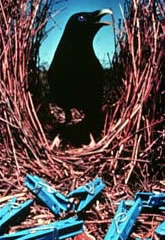
In the jungles of New Guinea there’s a species of bird called the Bowerbird. To attract a mate, the male Bowerbird builds an elaborate love nest. The door is made of woven grass. Its graceful shape beckons. He’s got Marvin Gaye playing on a cassette deck. Let’s get it on.
But he’s not done yet.
Now the intrepid male goes out and collects a wild array of stuff, shells, bottle caps, bits of colored plastic, the shiny wing feathers of beetles and arranges it around the perimeter, marking out a circle around the front door. This whole time he’s barely eating or sleeping. He’s wound up tight. He’s burning calories like a madman.
When the nest is just right, the male Bowerbird breaks out in song.
Four notes over and over.
If he can keep up a steady beat, any female within earshot knows he’s got good genes or whatever. Probably they aren’t thinking about genetics at all.
What strange birds are we?
I read an article in Scientific American Mind about music preferences in humans. Different personality types prefer different levels of complexity in music art and literature. Extroverts love mainstream pop, they love magazines, and Mark Rothko. Introverts love dissonance, byzantine novels, and Albrecht Durer.
Extroverts want their expectations fulfilled.
Introverts want to be confused.
These are gross generalizations, but see if they ring true for you.
(You’ll see where I’m going with this in a second.)
We were having dinner at the Bombay Cricket Club with our niece Elizabeth and her husband Don. He was talking about when they were first dating.
“Elizabeth asked me, ‘what kind of music do you like?’ Don said, ‘I like this and I like that, and…um…I like a little country.’ I was embarrassed about it, you know? Then I look at her CD collection and it’s like country, country, country.”
At this point in the story Don gives me this look like, ‘Yup…that’s when I knew.’
Zip back 35 years, to 1975.
I loved the Mahavishnu Orchestra. No girls liked this stuff. It was jazz-jock music for psychos. Music for Introverts. No girls had even heard of them.
Then I met Valerie Day.
Not only had she heard of them, she saw them play at the Paramount.
Yup.
That’s when I knew,
She was the one.
Bye for now.
~JRS
Nu Shooz Band
P.S. Weirdly enough, it was "Birds of Fire" that became "our song". How's that for my unconscious mind starting this blog with a bit about birds?
P.S.S. Was music a part of YOUR mating dance? We’d love to hear from you! Please leave a comment below...
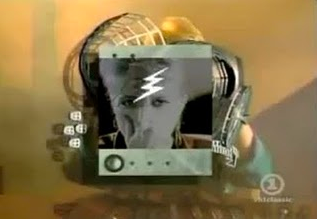
I Can’t Wait: The Video…What IS It All About?
Since it first appeared in 1986 during the heyday of MTV, people having been asking us about the video for “I Can’t Wait”. What is the meaning behind it all? Why is Valerie pulling a shark out of a coffee pot? Is the dog wearing sunglasses a part of the band?
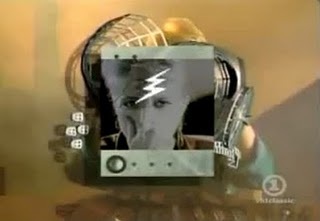
Since it first appeared in 1986 during the heyday of MTV, people have been asking us about the video for “I Can’t Wait”. What is the meaning behind it all? Why is Valerie pulling a shark out of a coffee pot? Is the dog wearing sunglasses a part of the band?
John and I have always loved the video for I Can’t Wait. Working on it with Jim Blashfield was one of the highlights of our pop music career. Jim lives in Portland with his wife, Mellisa Marsland (who also produced the video), and his daughter Hallie. We have gotten to be good friends with Jim and his family over the years. We even got to work with Jim recently on a multi-media performance called Brain Chemistry For Lovers. Jim directed, edited the script, and created video for it. Over the years, we’ve had a few discussions about the music business and assorted other music-related topics, but because the video for ICW had always “made sense” on a non-literal level to us, John and I had never thought to ask Jim, “What was that all about?”
Enter Sloan de Forest, a woman who calls herself “the Pauline Kael of classic MTV.” Sloan had a blog called “Images of Heaven: Remembering The Lost Art of Music Video.” She had decided it was time to uncover the story behind the “making of” ICW. She emailed Jim. He responded and copied us on the email. The blog no longer exists, but Jim's response does. Here it is in its entirety:
The video came about because I was a filmmaker living in Portland and my producer Melissa Marsland and I had just finished our first video, And She Was, and another for Joni Mitchell called Good Friends, and our fellow Portlanders-- the Nu Shooz crew who had been having some big international dance hits-- asked us to do a video for them. I explained that I wanted to improvise it. I didn't want to plan it at all. I wanted the experience of just making it up from what was around when we got to the studio. The morning of the shoot, I loaded my kitchen table and chair, and lamp into my car, along with some biology slides and a coffee maker, and some kind of cigar box, and headed over to the stage.
I rummaged around among the props there and found some canvas and some walls from a commercial, and some fake cactuses. I went upstairs, where the band and the crew were assembled-- we had a good and very professional crew, as you can tell from looking at the images-- and told them I would be back in 10 minutes with instructions about setting up for the first shot, about which I had no idea whatsoever. I rummaged around in people's offices and borrowed a few other items which looked promising. I went upstairs and said we were doing a video that took place in the desert and set people about creating that. It seemed like we needed something in front of the green walls, so the video editor went down the street and came back with a dumpster and rigged a way to make the lid go up and down with fishing line.
I recalled that my friends who were on vacation had a great-looking dog house for their dog Buster and some people went there and stole it. We called up a friend with an obedient dog who would stay when asked, and he brought his pooch over. Somebody else got a bunch of tools out of the trunk of their car. Now, fully prepared, with the band members doing an admirable job of hiding their apprehension, we were all set to shoot the live-action! Valerie was completely along for the ride with a great sense of playfulness, as her song was absolutely misinterpreted.
After the shoot, the next step was a trip to Seattle to get the footage transferred and do strange things to some of it, and then, for post-production, a trip to the thrift store and the corner grocery, returning with every other little gadget and doo-dah you see on the screen.
The video editor was Mike Quinn, who subsequently did the high-degree-of-difficulty video editing for my videos for Paul Simon, Peter Gabriel, and others. During editing, I called my friend Roger Kukes, the animator, and asked him if I could use part of his animated film Up for the ending of the video where Valerie Day opens the little box, and all the wiggly images come out, revealing all knowledge known to humankind.
I recall that the opening scene with the Banana and souvenir totem pole dropping onto a piece of metal with holes in it took about 8 hours to composite and was completed while I slept on the couch in the editing room. The scene where the image of the dog watching the golf ballish thing swings in and unceremoniously lands on Valerie's head-- and where it remains for longer than might be considered, strictly speaking, necessary-- is there because it made me laugh when we tried it in post and was left in because nobody said I couldn't. We had a take in which the guy with the smoke machine walks through in the background, waving it around while Valerie is singing, but I left that out due to some conservative impulse on my part, which I regret.
When they saw the video, the record company called it "unusual," or perhaps "quite unusual," or maybe "very unusual," or possibly some other less neutral phrase that I have repressed.
So what is it? Besides being a promo for a band and a song, it is an experiment to see what results when you take a line from the video "tell me what it's all about" and decide that Valerie is some kind of a scientist with an interest in small appliance repair instead of somebody waiting, lovesick, for a phone call, and let everything follow logically from that. If viewers look closely, they may notice that happiness seems to be represented as a shark found lurking in a coffee pot, a metaphor which is certainly worth considering if you ask me.
This being Portland and Nu Shooz being Nu Shooz and me being something of a troublemaker with a perhaps overdeveloped allegiance to the ordinary, the Portland MTV video premiere party was held in a truck-stop cafe and bar up the street. The local news sent a mobile truck to broadcast the glamorous event live.
By the way, and not incidentally, Valerie Day and John Smith, the Nu Shooz core, are fabulous and very versatile musicians and have a new CD out, Pandora's Box, that is exquisitely produced, hypnotically beautiful and completely different from the zillion seller Poolside, of which I Can't Wait was a part. I didn't have in mind to promote their CD when I began this fascinating run-on mind-evacuation, but since I'm talking about it... https://nushoozorchestra.bandcamp.com/album/pandoras-box
So hey, thanks for your interest, Sloan. I agree that some pretty interesting work was made during that period, and am aware that my co-conspirators and I were behind a few of the more interesting ones. That was our intention. To do stuff that bent the expected trajectory or looked deeper, or cast light and attention on subjects, images, and ways of seeing things that were often overlooked. Thanks for appreciating that!
I must go now and milk the swan.
Jim Blashfield
Reading Jim’s account of how the video came together made us appreciate him even more than we already do. And what a blast to have his version of the making of! He’s a master at using images to explore that theme park of the mind – the unconscious – and give us all a great time while doing it.
Thought I’d share it with you.
- Valerie
How to Get A Hit Record and Sell a Million Records
Want to know how to achieve FAME and FORTUNE in the music business? Yes, YOU can be a pop sensation. Check out our very tongue-in-cheek entry on "The One Minute How To," as we tell you the secret of "How to Get A Hit Record and Sell a Million Records." It's a fun show, hosted by George Smyth. In this educational, 550-episode series, you can learn everything under the sun from how to unclog your drain to how to ride a Bactrian camel, and all in sixty seconds.
Follow along with the interview here:

Want to know how to achieve FAME and FORTUNE in the music business? Yes, YOU can be a pop sensation. Check out our very tongue-in-cheek entry on "The One Minute How To" below as we tell you the secret of "How to Get A Hit Record and Sell a Million Records." It's a fun show hosted by George Smyth. In this educational, 550-episode series, you can learn everything under the sun, from how to unclog your drain to how to ride a Bactrian camel and all in sixty seconds.
Follow along with the interview here:
GS: Hello, everyone. This is George, your host. On this show, we’ve got Valerie Day and John Smith, and they’re going to explain to us How to Get a Record Deal and Sell a Million Records. Guys, can you first tell us a little something about yourselves?
VJD: Well, we had a band in the heyday of MTV called NU SHOOZ that racked up some Top-40 hits, one of which still plays somewhere on Earth every eleven minutes. Before our ‘overnight success’ though, we spent seven years playing clubs, touring in a broken-down school bus, and recording when we could scrape up the money. So this How-To will give people a leg up on the step-by-step process we took to go from local obscurity to international stardom.
GS: OK, if you’re ready, then you’ve got sixty seconds.
VJD: How to Get a Record Deal and Sell a Million Records.
JRS: Start a band, make a poster, and, oh yeah…Choose a band name.
Remember…
You’ll be stuck with it for life.
Play four or five nights a week
Four hours a night
For seven years
Oh, and don’t forget to record.
You never know
Which track
Is going to be MAGIC.
We sure didn’t know.
Get your recording reviewed in the local newspaper.
Make sure the writer says something about how you suck as a live band.
But that it’s too bad that Top-40 stations in town won’t play local music.
‘Cause the recording’s actually pretty good.
Have a DJ from the Number One pop station in your city read the review…
And put a call out over the air to bring the tape on down. They’ll pick a song and play it on the radio.
Then the next year, becoming a Regional Hit.
So you can get turned down by all the major labels.
Put your single out on a 12” record for dance clubs
Have a remix artist
In Holland
Find your record in a record store bin
In Holland
Have him remix it.
So he can send HIS remix back to the states.
Where it can wind up in all the New York City dance clubs
To be discovered by a nice Italian boy who happens to work at the Dance Department at Atlantic Records
Where his boss will hear it and sign you to a singles deal
That turns into an album deal
That produces more Top-40 Hits
That get you nominated for a Best New Artist Grammy
And help you sell over a million records worldwide.
GS: (Laughs) I’m hearing this and what takes me back to when I was in bands was the four-hour gigs, and you happened to mention that, and I guess that’s something that’s rather common.
JRS: Oh yeah.
VJD: Back in the day. Now people have opening acts in clubs and stuff, but we played the whole time.
GS: Yeah, yeah. I can remember it would be like either an eight to twelve gig or like a ten to two gig, and they’d give you one, maybe two breaks, and…not so easy.
VJD: No, no, It’s a good way to learn though.
GS: Absolutely.
VJD: Yeah.
GS: OK, Is there anything else that you’d like to talk about?
VJD: Well, first of all, there’s really no step-by-step guide, as you know, that can help you to get a record deal or sell a million records, but the point of the whole story is that if you really, really really want to do something badly enough, you’ll just have to keep going no matter what because you have to do it for you. And since the 80’s, we’ve been doing all kinds of music, everything from Jazz to Classical, Film Scores to Funk, and we got excited about combining our favorite styles to create a new sound. So, we put together a new band called The NU SHOOZ Orchestra, and we just released our first CD. It’s called Pandora’s Box, and you can find it on our website, nushoozmusic.com. We’ve got free tracks there, full streams for listening, and links to places you can buy actual physical copies of the CD if you want.
GS: And Nu Shooz is spelled N-U-S-H-O-O-Z.
JRS: That’s right.
GS: OK. I’ll have a link to that on the One Minute How-To dot com show notes.
VJD: Thanks, George.
GS: Valerie and John, thanks a lot. I appreciate it.
JRS: Thanks for having us. It’s been fun.
VJD: It’s been really fun


![Welcome to your summer. Yes, it's finally here! And it's the 46th anniversary of the very first NuShooz gig. [Colonel Summer's Park, Portland, Oregon, June 21st, 1979.] What a different world that was; pre-internet, no smartphones or smart toasters,](https://images.squarespace-cdn.com/content/v1/54cee645e4b01fa0f0bfc5f9/1750512289030-8M6PFU9H9F6KHZ2HFJ94/image-asset.jpeg)